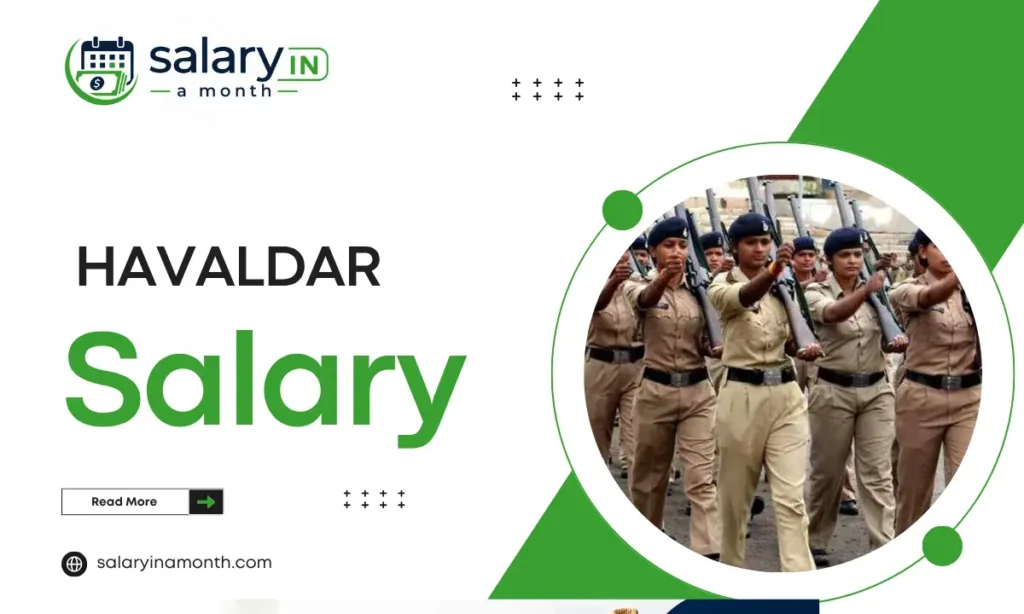
The term Havaldar refers to more than one job in India, which often confuses candidates researching pay online. It can mean a non-commissioned officer rank in the Indian Army, a Group C post under the Staff Selection Commission attached to Customs and Central GST departments, or, in some state police forces, a designation roughly equivalent to Head Constable. Each of these carries its own separate pay scale, even though the title sounds identical.
This article breaks down Havaldar salary across all three common contexts for 2026: Army Havildar pay under the Defence Pay Matrix, SSC Havaldar pay under the general civilian pay matrix, and police Havaldar pay, along with allowances, city-wise differences, eligibility, and the career growth path in each track.
Havaldar Salary: Quick Overview
| Category | Basic Pay | Approximate In-hand Salary |
|---|---|---|
| Army Havildar | Rs 29,200 (Level 5, Defence Pay Matrix) | Rs 42,000 to Rs 55,000, higher in field areas |
| SSC Havaldar (Customs/CGST) | Rs 18,000 (Level 1) | Rs 24,000 to Rs 35,000 |
| Police Havaldar (Head Constable equivalent) | Varies by state, generally Level 3 to 4 | Rs 28,000 to Rs 40,000 |
Army Havildar Salary Structure
A Havildar in the Indian Army holds a Non-Commissioned Officer (NCO) rank under the Other Ranks (OR) category, placed at Pay Level 5 of the Defence Pay Matrix, above Naik and below Naib Subedar.
| Salary Component | Approximate Amount |
|---|---|
| Basic Pay | Rs 29,200 |
| Military Service Pay (MSP) | Rs 5,200, fixed for all Other Ranks |
| Dearness Allowance (DA), current rate | Around Rs 20,000 to Rs 21,000, calculated on Basic plus MSP |
| House Rent Allowance (HRA) | Rs 2,600 to Rs 7,900, depending on city category, not applicable in field postings with quarters |
| Transport Allowance | Rs 1,350 to Rs 3,600 |
| Field / Operational Allowance | Rs 3,000 to Rs 16,900, applicable at high-altitude, field, or counter-insurgency postings |
Army Havildar In-Hand Salary by Posting Type
| Posting Type | Approximate In-hand Salary |
|---|---|
| Peace Station Posting | Rs 42,000 to Rs 55,000 |
| Field Area Posting | Rs 52,000 to Rs 70,000 |
| High-Altitude / Counter-Insurgency Posting | Higher still, due to additional risk and hardship allowances |
An Army Havildar typically reaches this rank after around 8 to 12 years of service, moving up from Sepoy and Naik, with the exact timeline depending on vacancy, performance, and the specific regiment or corps.
SSC Havaldar Salary Structure (Customs and CGST)
The SSC Havaldar post is recruited through the Staff Selection Commission for the Central Board of Indirect Taxes and Customs (CBIC) and Central Bureau of Narcotics (CBN) under the Ministry of Finance, and is a Group C, non-gazetted, non-ministerial post.
| Salary Component | Details |
|---|---|
| Pay Level | Level 1 (7th Pay Commission) |
| Basic Pay | Rs 18,000 |
| Pay Scale | Rs 18,000 to Rs 56,900 |
| Post Type | Group C, Non-Gazetted, Non-Ministerial |
SSC Havaldar Monthly Salary by City Category
| Component | X City (Metro) | Y City (Major Town) | Z City (Other Areas) |
|---|---|---|---|
| Basic Pay | Rs 18,000 | Rs 18,000 | Rs 18,000 |
| Dearness Allowance | Rs 10,800 | Rs 10,800 | Rs 10,800 |
| House Rent Allowance | Rs 4,860 | Rs 3,240 | Rs 1,620 |
| Transport Allowance | Rs 1,350 | Rs 900 | Rs 900 |
| Other Allowances | Rs 500 to Rs 1,000 | Rs 500 | Rs 500 |
| Gross Salary | Rs 35,510 to Rs 36,010 | Rs 33,440 | Rs 31,820 |
| Deductions (NPS, CGHS, CGEGIS, tax) | Rs 3,500 to Rs 5,000 | Rs 3,000 to Rs 4,500 | Rs 2,500 to Rs 4,000 |
| Net In-hand Salary | Rs 28,000 to Rs 32,000 | Rs 26,000 to Rs 30,000 | Rs 24,000 to Rs 28,000 |
Police Havaldar Salary Structure
In several state police forces, the Havaldar post is broadly equivalent to Head Constable, sitting above Constable and below Assistant Sub-Inspector in the hierarchy. Exact pay levels vary by state, since state police pay scales are set individually rather than under a single unified matrix.
| Component | Approximate Amount |
|---|---|
| Basic Pay | Rs 21,700 to Rs 25,500, depending on state pay scale (Level 3 to 4) |
| Dearness Allowance | Revised periodically, generally 50 to 58 percent of basic pay |
| House Rent Allowance | 8 to 24 percent of basic pay, depending on city category |
| Other Allowances | Uniform, ration, and other state-specific allowances |
| Approximate In-hand Salary | Rs 28,000 to Rs 40,000, depending on state and posting |
Havaldar Salary Compared to Similar Government Posts
| Role | Approximate In-hand Salary |
|---|---|
| Havaldar (SSC, Customs/CGST) | Rs 24,000 to Rs 35,000 |
| Army Havildar | Rs 42,000 to Rs 55,000 (peace posting) |
| Police Constable | Rs 20,000 to Rs 30,000 |
| Army Naik | Rs 25,000 to Rs 40,000 |
| Army Sepoy | Rs 25,000 to Rs 35,000 |
| Multi-Tasking Staff (MTS) | Rs 20,000 to Rs 30,000 |
Eligibility Criteria
| Category | Typical Requirement |
|---|---|
| Army Havildar (direct entry, where applicable) | Class 10 or 12 pass, physical fitness standards, and Army recruitment test, though most reach this rank through internal promotion from Sepoy and Naik |
| SSC Havaldar | Class 10 pass from a recognized board, along with prescribed physical standards |
| Police Havaldar / Head Constable equivalent | Class 10 or 12 pass depending on the state, along with physical efficiency and written examination as per state police recruitment rules |
| Age Limit | Generally 18 to 25 years for direct entry posts, varying by department and category |
Career Growth and Promotion Path
Army Track
| Rank | Approximate Years of Service |
|---|---|
| Sepoy | Entry level |
| Naik | 3 to 5 years |
| Havildar | 8 to 12 years |
| Naib Subedar | 15 to 18 years |
| Subedar | 18 to 22 years |
SSC Customs/CGST Track
| Stage | Approximate Basis for Promotion |
|---|---|
| Havaldar | Entry level, Group C |
| Senior Havaldar / Sepoy Grade Progression | Seniority and departmental exams |
| Inspector (higher cadre) | Limited departmental competitive exam route, subject to vacancy |
Police Track
| Rank | Position Relative to Havaldar |
|---|---|
| Constable | Below Havaldar / Head Constable |
| Havaldar / Head Constable | Entry supervisory rank |
| Assistant Sub-Inspector | Next promotion stage |
| Sub-Inspector | Further promotion, subject to seniority and departmental exams |
Perks and Benefits Beyond Salary
- Job security as a central or state government employee, across all three Havaldar tracks.
- Medical facilities and health coverage for the employee and eligible family members.
- Pension benefits under the National Pension Scheme, along with other standard government employee benefits.
- Government quarters or housing at many postings, particularly for Army and police personnel.
- Field, risk, and hardship allowances for Army Havildars posted in difficult terrain or operational areas.
- Structured promotion pathway in all three tracks, based on seniority, performance, and departmental exams.
Frequently Asked Questions
What is the salary of an Army Havildar in India?
An Army Havildar’s basic pay is Rs 29,200 per month under Pay Level 5 of the Defence Pay Matrix, with Military Service Pay of Rs 5,200 added on top. The approximate in-hand salary ranges from Rs 42,000 to Rs 55,000 at a peace posting, and higher at field or high-altitude postings.
What is the salary of an SSC Havaldar?
An SSC Havaldar, recruited for Customs and CGST departments under the Ministry of Finance, has a basic pay of Rs 18,000 per month under Pay Level 1, with an approximate in-hand salary between Rs 24,000 and Rs 35,000 depending on the city of posting.
Is Havaldar the same as Head Constable in police forces?
In many state police forces, Havaldar is used as an equivalent or alternate designation to Head Constable, sitting above Constable and below Assistant Sub-Inspector, though the exact terminology and pay scale can vary from state to state.
How long does it take to become a Havildar in the Indian Army?
Most soldiers reach the Havildar rank after approximately 8 to 12 years of service, having first been promoted from Sepoy to Naik, with the exact timeline depending on vacancy, performance, and the specific regiment or corps.
Does posting location affect Havaldar salary?
Yes, across all three tracks. SSC Havaldars posted in metro or X-category cities receive a higher House Rent Allowance than those in smaller towns, while Army Havildars posted in field or high-altitude areas receive additional operational and hardship allowances on top of the standard pay.
What is the minimum qualification needed to become a Havaldar?
For SSC Havaldar posts, a Class 10 pass from a recognized board is generally required. Police Havaldar or Head Constable posts typically require Class 10 or 12 depending on the state, while Army Havildar is most commonly reached through internal promotion rather than direct entry at that rank.
Which Havaldar post pays the most?
Among the three common tracks, Army Havildar generally offers the highest in-hand salary, particularly when posted in field or operationally difficult areas, due to the addition of Military Service Pay along with field and hardship allowances that are not present in the SSC or typical police pay structures.
Can an SSC Havaldar get promoted to a higher post?
Yes, SSC Havaldars in Customs and CGST departments can progress through seniority-based promotions and departmental exams over time, with a limited departmental route also available toward higher cadre posts such as Inspector, subject to vacancy and eligibility.
Also know: Lighthouse Job Salary in India 2026: Pay Scale, In-Hand Salary, Allowances, and Career Growth