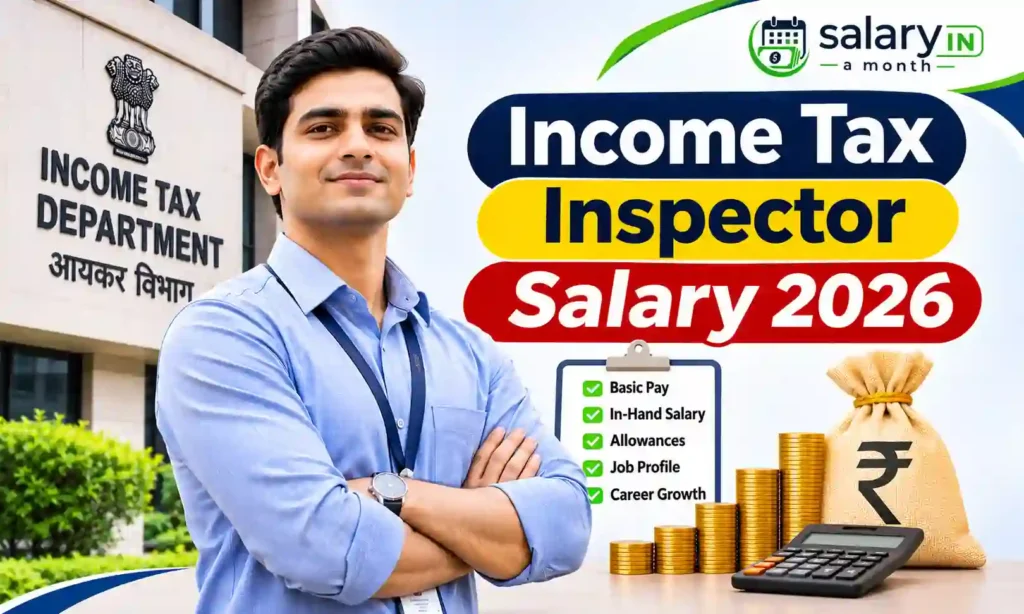
Becoming an Income Tax Inspector is a popular career choice among candidates preparing for government jobs in India. The position offers an attractive salary, job security, respectable status and opportunities for promotion within the Income Tax Department. It is a Group B, non-gazetted post recruited primarily through the Staff Selection Commission Combined Graduate Level (SSC CGL) examination.
One of the biggest reasons candidates prefer this position is its salary structure. An Income Tax Inspector receives a basic salary under Pay Level 7 of the 7th Central Pay Commission, along with several allowances and government benefits. The actual monthly salary depends on the city of posting, applicable allowances and deductions.
In 2026, the basic pay of an Income Tax Inspector starts at ₹44,900 per month. The pay scale extends up to ₹1,42,400, providing considerable scope for salary growth through annual increments and promotions.
This article explains the Income Tax Inspector salary in detail, including basic pay, gross salary, in-hand salary, HRA, DA, transport allowance, deductions, job responsibilities, eligibility, selection process and career progression.
What Is an Income Tax Inspector?
An Income Tax Inspector is a government employee working under the Income Tax Department, which operates under the Central Board of Direct Taxes (CBDT), Ministry of Finance, Government of India.
The primary responsibility of an Income Tax Inspector is to assist the department in implementing income tax laws and ensuring compliance with tax regulations. Inspectors may work in different sections, including assessment, non-assessment, investigation and tax administration.
The job involves examining financial information, verifying records, assisting senior officers, handling taxpayer-related matters and supporting departmental operations.
Candidates are generally recruited through the SSC CGL examination. After selection, they are appointed to the Income Tax Department and assigned responsibilities according to departmental requirements.
Income Tax Inspector Salary 2026: Overview
Here is a quick overview of the Income Tax Inspector salary and job details.
| Particulars | Details |
|---|---|
| Post Name | Income Tax Inspector |
| Department | Income Tax Department |
| Ministry | Ministry of Finance |
| Recruiting Authority | Staff Selection Commission |
| Examination | SSC CGL |
| Pay Commission | 7th Pay Commission |
| Pay Level | Level 7 |
| Grade Pay (Legacy) | ₹4,600 |
| Basic Salary | ₹44,900 |
| Maximum Basic Pay in Level | ₹1,42,400 |
| Pay Scale | ₹44,900 – ₹1,42,400 |
| Job Category | Group B, Non-Gazetted |
| Employment Type | Central Government |
| Dearness Allowance | As Applicable |
| House Rent Allowance | As Applicable |
| Transport Allowance | As Applicable |
| Promotion | Departmental Promotion |
Income Tax Inspector Basic Salary
The basic salary of an Income Tax Inspector is ₹44,900 per month under Pay Level 7.
The position comes under the Level 7 pay matrix, which has a salary range of ₹44,900 to ₹1,42,400. The starting basic pay is determined by the applicable pay rules and the employee’s appointment details.
Basic pay is an important component of government salary because several allowances and retirement-related benefits are calculated with reference to it.
| Salary Particulars | Amount |
|---|---|
| Pay Level | Level 7 |
| Starting Basic Pay | ₹44,900 |
| Maximum Basic Pay | ₹1,42,400 |
| Legacy Grade Pay | ₹4,600 |
| Pay Commission | 7th CPC |
| Annual Increment | Generally 3% |
The annual increment increases the basic salary according to the pay matrix. Over time, this leads to higher monthly earnings, even without a promotion.
Income Tax Inspector Monthly Salary Breakdown 2026
The monthly salary of an Income Tax Inspector includes basic pay, Dearness Allowance, House Rent Allowance and Transport Allowance. The total salary changes according to the employee’s posting location.
For November 2026, the latest announced Dearness Allowance rate is 63% of basic pay, effective from 1 July 2026. HRA rates are generally 30%, 20% and 10% for X, Y and Z category cities, respectively, after the applicable DA threshold is crossed.
Salary Components
| Salary Component | Amount / Rate |
|---|---|
| Basic Pay | ₹44,900 |
| Dearness Allowance (DA) | 63% |
| DA Amount | ₹28,287 |
| HRA (X City) | 30% |
| HRA (Y City) | 20% |
| HRA (Z City) | 10% |
| Transport Allowance | ₹3,600 or ₹1,800 |
| Annual Increment | Generally 3% |
Gross Salary of Income Tax Inspector
The following table provides an illustrative salary calculation for a newly appointed Income Tax Inspector.
| Particulars | X City | Y City | Z City |
|---|---|---|---|
| Basic Pay | ₹44,900 | ₹44,900 | ₹44,900 |
| DA (63%) | ₹28,287 | ₹28,287 | ₹28,287 |
| HRA | ₹13,470 | ₹8,980 | ₹4,490 |
| Transport Allowance | ₹3,600 | ₹3,600 | ₹1,800 |
| DA on Transport Allowance | ₹2,268 | ₹2,268 | ₹1,134 |
| Gross Monthly Salary | ₹92,525 | ₹88,035 | ₹80,611 |
These are illustrative calculations. Transport allowance depends on the city classification for transport allowance, which is not always identical to the HRA city category.
Income Tax Inspector In-Hand Salary 2026
Gross salary and in-hand salary are two different things. Gross salary includes all applicable salary components before deductions, whereas in-hand salary is the amount credited to the employee’s bank account.
An Income Tax Inspector generally has deductions related to the National Pension System (NPS), CGHS, CGEGIS and applicable income tax.
The employee’s actual deductions depend on the applicable pension option, tax regime, exemptions and other personal circumstances.
Estimated In-Hand Salary
| Posting Category | Approx. Gross Salary | Estimated In-Hand Salary |
|---|---|---|
| X City | ₹92,525 | ₹82,000 – ₹85,000 |
| Y City | ₹88,035 | ₹77,000 – ₹81,000 |
| Z City | ₹80,611 | ₹70,000 – ₹74,000 |
These are indicative estimates, not official fixed take-home amounts. Income tax, NPS contributions and other deductions can change the final salary.
What Deductions Are Made From Income Tax Inspector Salary?
1. National Pension System (NPS)
Newly recruited central government employees are generally covered under the applicable pension framework, including NPS or the Unified Pension Scheme where eligible and opted for. Under NPS, the employee contribution is generally 10% of basic pay plus DA.
2. Central Government Health Scheme (CGHS)
Employees covered by CGHS may have a monthly contribution deducted according to their pay level. This provides access to eligible government healthcare facilities.
3. Central Government Employees Group Insurance Scheme (CGEGIS)
A small monthly contribution may be deducted under the group insurance scheme, subject to applicable membership rules.
4. Income Tax
Income tax may be deducted from salary depending on the employee’s total taxable income, selected tax regime and applicable deductions.
Income Tax Inspector Salary During Training
Candidates selected through SSC CGL must complete the required departmental training after appointment.
During the training period, employees receive salary according to their appointed pay level and applicable government service rules.
| Particulars | Details |
|---|---|
| Basic Pay | ₹44,900 |
| Pay Level | Level 7 |
| Training | Departmental Training |
| Salary | As Per Applicable Pay Rules |
| Allowances | As Per Eligibility |
| Training Purpose | Tax Administration and Departmental Work |
Training generally introduces new recruits to income tax laws, departmental procedures, assessment work, investigation-related processes and administrative responsibilities.
Income Tax Inspector Salary After 5, 10 and 15 Years
The salary of an Income Tax Inspector increases with annual increments and promotions. Employees receive regular increments according to the pay matrix, subject to applicable service rules.
The following table provides an illustrative basic pay progression assuming continuous service in Level 7 without promotion.
| Service Period | Approx. Basic Pay |
|---|---|
| At Joining | ₹44,900 |
| After 5 Years | ₹51,900 |
| After 10 Years | ₹60,000 |
| After 15 Years | ₹69,300 |
| After 20 Years | ₹80,100 |
| After 25 Years | ₹92,500 |
These figures are approximate pay-matrix progression estimates. Actual basic pay depends on increment dates, promotions, pay fixation and applicable service rules.
Income Tax Inspector Allowances and Benefits
Apart from basic salary, Income Tax Inspectors receive several allowances and employment benefits available to eligible Central Government employees.
These facilities make the position financially attractive and provide additional support during government service.
1. Dearness Allowance (DA)
Dearness Allowance is provided to central government employees to help compensate for inflation and changes in the cost of living.
It is calculated as a percentage of basic pay and revised periodically by the government.
2. House Rent Allowance (HRA)
HRA is provided to eligible employees who do not receive government accommodation.
The applicable HRA rate depends on the city category.
| City Category | HRA Rate |
|---|---|
| X Category | 30% |
| Y Category | 20% |
| Z Category | 10% |
3. Transport Allowance (TA)
Transport Allowance helps employees manage their daily commuting expenses.
For Pay Level 3 and above, the standard rates are generally ₹3,600 per month in notified higher TPTA cities and ₹1,800 in other places, with applicable DA on the allowance.
4. Medical Facilities
Eligible employees can receive medical facilities under the Central Government Health Scheme or other applicable government healthcare arrangements.
5. Paid Leaves
Income Tax Inspectors receive leave benefits under Central Government service rules.
These may include:
- Casual Leave.
- Earned Leave.
- Half Pay Leave.
- Maternity Leave, where applicable.
- Paternity Leave, where applicable.
- Other admissible leave benefits.
6. Pension Benefits
Central Government employees recruited under the applicable pension framework receive retirement-related benefits. Eligible employees may be covered by NPS or the Unified Pension Scheme, subject to the relevant rules and options.
7. Government Accommodation
Eligible employees may apply for government residential accommodation according to availability, entitlement and applicable allotment rules.
If government accommodation is allotted, HRA is generally not payable for the same period.
8. Paid Holidays
Employees receive government-declared holidays and weekly rest arrangements according to departmental working requirements.
Income Tax Inspector Job Profile and Responsibilities
An Income Tax Inspector performs various administrative, financial and tax-related duties under the supervision of senior departmental officers.
The nature of work depends on the section in which the inspector is posted. Some employees perform office-based duties, while others may be assigned field responsibilities.
1. Assessment-Related Work
Inspectors posted in assessment sections assist in examining income tax records, financial documents and taxpayer information.
They help senior officers with assessment-related procedures and departmental verification work.
2. Investigation Work
Some inspectors work in investigation-related sections where they assist in identifying possible tax evasion, collecting information and examining financial transactions.
3. Taxpayer Assistance
An Income Tax Inspector may help taxpayers understand departmental procedures and assist with tax-related administrative matters.
4. Document Verification
Inspectors may examine financial records, supporting documents and other information submitted during departmental proceedings.
5. Field Duties
Depending on the posting, inspectors may participate in surveys, inspections and other authorised departmental activities under the supervision of senior officers.
6. Office Administration
They may also maintain records, prepare reports, process files and assist senior officials with daily departmental work.
Income Tax Inspector Eligibility Criteria 2026
Candidates who want to become Income Tax Inspectors must qualify for the SSC CGL examination and satisfy the eligibility requirements mentioned in the official notification.
Educational Qualification
Candidates must have a bachelor’s degree from a recognised university or an equivalent qualification.
| Particulars | Eligibility |
|---|---|
| Educational Qualification | Bachelor’s Degree |
| University | Recognised University |
| Final-Year Candidates | Subject to SSC notification conditions |
| Stream | Any Discipline |
| Minimum Percentage | No specific minimum percentage generally prescribed |
Students from Arts, Commerce, Science and other recognised academic streams can apply if they meet the eligibility conditions.
Age Limit
The usual age limit for the Income Tax Inspector post is 18 to 30 years.
Age relaxation is available for eligible reserved categories according to government rules.
| Category | Age Relaxation |
|---|---|
| General / UR | No Relaxation |
| OBC | 3 Years |
| SC / ST | 5 Years |
| PwBD | As Per Government Rules |
| Ex-Servicemen | As Per Applicable Rules |
The cut-off date for calculating age and the applicable relaxations are determined by the SSC CGL notification.
SSC CGL Income Tax Inspector Selection Process
The Staff Selection Commission conducts the Combined Graduate Level examination to recruit candidates for Income Tax Inspector positions.
The selection process generally includes the following stages:
Selection Process
- SSC CGL Tier 1Candidates appear for the preliminary computer-based examination.
- SSC CGL Tier 2Qualified candidates appear for the main computer-based examination.
- Document VerificationEducational certificates, identity documents and other required records are verified.
- Post AllocationCandidates are allocated posts according to merit, preferences, vacancies and applicable rules.
- Appointment and TrainingSelected candidates complete joining formalities and departmental training.
There is generally no separate interview for the Income Tax Inspector post under the SSC CGL recruitment process.
Income Tax Inspector Career Growth and Promotion
Career progression is another major attraction of the Income Tax Inspector position. Employees can move to higher posts through departmental promotions, subject to seniority, eligibility, vacancies and applicable departmental rules.
The career path generally includes the following positions:
Income Tax Department Promotion Hierarchy
- Income Tax Inspector
- Income Tax Officer (ITO)
- Assistant Commissioner of Income Tax
- Deputy Commissioner of Income Tax
- Joint Commissioner of Income Tax
- Additional Commissioner of Income Tax
- Commissioner of Income Tax
Illustrative career hierarchy. Higher promotions depend on service conditions, recruitment rules and vacancies.
Income Tax Inspector to Income Tax Officer Promotion
The first major promotion for an Income Tax Inspector is generally to Income Tax Officer (ITO).
Promotion depends on departmental seniority, eligibility, examination requirements where applicable and available vacancies.
After becoming an ITO, employees can progress to higher administrative positions through departmental promotion channels.
Income Tax Inspector Salary After Promotion
Promotion to a higher designation generally brings an increase in basic pay and additional responsibilities.
The following table shows the entry basic pay associated with relevant pay levels.
| Designation | Pay Level | Starting Basic Pay |
|---|---|---|
| Income Tax Inspector | Level 7 | ₹44,900 |
| Income Tax Officer | Level 8 | ₹47,600 |
| Assistant Commissioner | Level 10 | ₹56,100 |
| Deputy Commissioner | Level 11 | ₹67,700 |
| Joint Commissioner | Level 12 | ₹78,800 |
| Additional Commissioner | Level 13 | ₹1,23,100 |
| Commissioner | Level 14 | ₹1,44,200 |
These are pay-matrix entry figures, not guaranteed salaries immediately after promotion. Actual pay fixation depends on the employee’s existing basic pay and applicable promotion rules.
Difference Between Income Tax Inspector and Income Tax Officer
Many candidates confuse an Income Tax Inspector with an Income Tax Officer because both work in the Income Tax Department.
However, these are different designations with different responsibilities and pay levels.
| Particulars | Income Tax Inspector | Income Tax Officer |
|---|---|---|
| Full Name | Inspector of Income Tax | Income Tax Officer |
| Department | CBDT | CBDT |
| Pay Level | Level 7 | Level 8 |
| Starting Basic Pay | ₹44,900 | ₹47,600 |
| Job Position | Inspector | Officer |
| Responsibilities | Verification and Departmental Assistance | Supervisory and Assessment Responsibilities |
| Recruitment | SSC CGL | Generally Through Promotion |
| Status | Group B, Non-Gazetted | Group B, Generally Gazetted |
An Income Tax Inspector can become an Income Tax Officer through the applicable departmental promotion process.
Is Income Tax Inspector a Good Government Job?
Yes, Income Tax Inspector is considered an attractive government career for graduates who want a stable job with good salary prospects and opportunities for professional growth.
However, candidates should understand the responsibilities and working conditions before choosing this post.
Advantages of Becoming an Income Tax Inspector
- Attractive starting basic salary.
- Central Government employment.
- Dearness Allowance and House Rent Allowance.
- Transport allowance and other admissible benefits.
- Medical facilities for eligible employees.
- Retirement-related benefits.
- Promotion opportunities.
- Opportunities to work in different locations.
- Professional experience in taxation and financial administration.
Challenges of the Job
- Competitive SSC CGL examination.
- Responsibility for handling confidential financial information.
- Strict departmental procedures.
- Possible field visits and investigation-related assignments.
- Work pressure during certain assessment periods.
- Transfers according to departmental requirements.
Overall, it is a suitable career for graduates interested in taxation, financial administration and government service.
Frequently Asked Questions (FAQs)
1. What is the Income Tax Inspector salary in 2026?
The starting basic salary of an Income Tax Inspector is ₹44,900 per month under Pay Level 7. Gross salary and in-hand salary are higher after adding applicable allowances.
2. What is the Income Tax Inspector in-hand salary?
The estimated monthly in-hand salary generally falls around ₹70,000 to ₹85,000, depending on the posting city, allowances and deductions.
3. What is the basic pay of an Income Tax Inspector?
The starting basic pay is ₹44,900 per month under the 7th Pay Commission.
4. What is the maximum salary of an Income Tax Inspector?
The maximum basic pay under Pay Level 7 is ₹1,42,400 per month, excluding allowances.
5. What is the Income Tax Inspector grade pay?
The legacy grade pay of an Income Tax Inspector is ₹4,600. Under the current pay matrix, the post comes under Pay Level 7.
6. Does an Income Tax Inspector receive HRA?
Yes, eligible employees receive House Rent Allowance according to their city category and applicable government rules.
7. What is the DA of an Income Tax Inspector in November 2026?
The latest announced Dearness Allowance rate is 63% of basic pay, effective from 1 July 2026.
8. Is Income Tax Inspector a Group B job?
Yes, the Income Tax Inspector is classified as a Group B, non-gazetted post.
9. Which exam is required to become an Income Tax Inspector?
Candidates must qualify for the Staff Selection Commission Combined Graduate Level (SSC CGL) examination and satisfy the post-specific eligibility requirements.
10. What is the educational qualification for an Income Tax Inspector?
Candidates generally need a bachelor’s degree from a recognised university. Students from any academic stream can apply.
11. Can an Income Tax Inspector become an ITO?
Yes, an Income Tax Inspector can receive promotion to Income Tax Officer through the applicable departmental promotion process.
12. Does an Income Tax Inspector get a pension?
Eligible employees receive retirement benefits under the applicable government pension framework, including NPS or the Unified Pension Scheme, subject to the relevant rules.
13. Is there an interview for Income Tax Inspector recruitment?
No separate interview is generally conducted for this post under the SSC CGL recruitment process.
14. What is the age limit for an Income Tax Inspector?
The usual age limit is 18 to 30 years, with applicable relaxations for eligible reserved categories.
15. Does an Income Tax Inspector have field duties?
Yes, depending on the posting, an inspector may perform field visits, verification, survey-related and other authorised departmental duties.
Conclusion
Income Tax Inspector is one of the attractive career options available through the SSC CGL examination. In 2026, the position offers a starting basic salary of ₹44,900 under Pay Level 7, along with DA, HRA, Transport Allowance and other applicable government benefits.
The estimated in-hand salary can range from approximately ₹70,000 to ₹85,000 per month, depending on the employee’s posting location and deductions. Apart from the salary, the job provides government service benefits, retirement provisions and opportunities for promotion to higher departmental positions.
Also know: SIS Security Salary 2026: Monthly Salary, In-Hand Pay, Guard, Supervisor and Officer Salary